
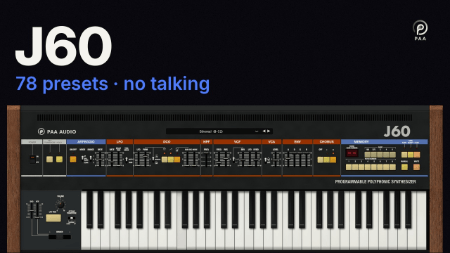
J60 | Six voices, one chorus, and the sound of the early 80s. Built from the original circuit, not from samples.
* Checked against the service manual. The manual lists the adjustments every unit got at the factory. We measured J60 against the same list: filter self-oscillation, envelope times, LFO rate and chorus.
* No samples. Oscillators, filter, VCA and envelope run as circuits while you play. Nothing is played back from recordings.
* Chorus I, II and both. The bucket-brigade delay lines are modelled too, including the earlier, slower version you hear on the factory demo tape.
* 253 presets. Both factory banks, the example patches from the original owner's manual and 98 presets of our own, sorted into 11 categories. If you want more, there are four preset packs with 40 sounds each.
The original is a simple instrument: one oscillator per voice, one filter, one envelope and a chorus. Most of its sound comes from how those parts behave in the actual circuit, not from the feature list. That behaviour is what we modelled.
You notice it when you play. The filter gets a different colour as you turn up the resonance, short envelopes have real snap, and held chords keep moving slightly instead of sounding frozen.
What you get
* Six voices: saw, pulse with PWM, sub oscillator and noise, a high-pass filter, the resonant low-pass filter and one envelope. Same layout as the original panel.
* Arpeggiator: Up, Down and Up & Down over one to three octaves, free running or synced to your DAW.
* Memory section: banks, patch numbers, Manual and Write, plus Key Transpose and Hold.
* Tape save and load in the original cassette format.
* Unison from the service manual: all six voices on one note. There is no detune, because all oscillators run from one clock. Add the chorus if you want it wider.
* Eco, Normal and High quality. Eco saves CPU while you work. Exports always render in High. Runs at 44.1 to 192 kHz.
PCCN™
Most emulations model the result: a curve, a filter formula or a recorded waveform. PCCN models the circuit itself and calculates it in real time while the audio runs through it. That is how details like the filter colour or the movement of the chorus come out the way they do on the hardware.
Home page
DOWNLOAD