
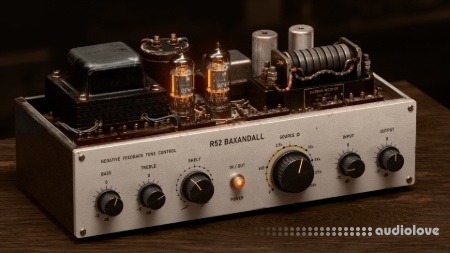
The 1952 circuit, as Peter Baxandall published it.
In October 1952, Wireless World printed a two-knob tone control with the EQ network inside a valve amplifier's feedback loop. The industry kept the shape and redrew everything else. R52 is the circuit itself: the SP61 pentode in the loop, the published component values, and the conditions Baxandall specified around it, source impedance and the amplifier at the far end, now under your fingers.
One network, not two bands.
BASS and TREBLE are two arms of one feedback network, so each changes what the other is working against. Lift both and the middle steps back; cut both and it comes forward. The SCOPE draws the interaction as you move.
The amplifier is inside the EQ.
The valve is not a saturation stage bolted on after the filter. It sits in the loop the curve is made of, so level is part of the sound: INPUT decides how much valve you hear, and a treble lift works the valve exactly where you lifted. Quiet is clean, loud is colored, and there is no clipping point in between.
The conditions are under your fingers.
In 1952 the source impedance and the amplifier at the far end were fixed by whatever hardware you owned. R52 puts them on the panel. SOURCE sets what feeds the network, LOAD sets how tightly the amplifier grips a 15 Ω monitor, and SHELF chooses between the two treble endings Baxandall published.
Home page
DOWNLOAD