
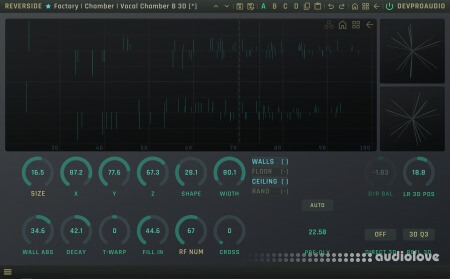
REVERSIDE is a versatile dual-engine fully algorithmic reverb with a geometry-driven 3D positioning and spatialisation system. It combines independent Early Reflections and Late Reflections engines, so you can shape clarity and the tail separately. Place a virtual source and listener inside a simulated space, and let the room geometry influence the directional character of both the early field and the reverb tail. Use it as a reverb and as a placement tool to build a coherent stage where multiple tracks feel like they belong to the same environment.
A pitch-preserving modulation system plus per-engine stereo, filters, and EQ keep the result rich and detailed without typical pitch smear. For fast work, use the Easy page and the preset library; for deeper design, open the dedicated editing pages for reflections, position, diffusion, filters, EQ, and modulation.
Early Reflections Engine
A detailed early-reflection field that maps out the space before the reverb tail arrives. Control room geometry, surface absorption, and source/listener positioning to define spatial cues — from tight, focused stages to wide, irregular chambers. A dedicated mini diffuser adds extra scattering and density for more natural, less "calculated" reflections.
Up to 200 reflections with AUTO mode that derives the count from room geometry
Room geometry with absolute and relative size modes for precise or proportional shaping
Shape control for room irregularity — from perfect box to chaotic, scattered surfaces
Wall Absorption and Fill for simulating real-world surface materials
Distance-induced Decay and frequency-dependent MAT (material) absorption
Bounce type options with Soft/Hard phase modes for different reflection characters
Azimuth/Elevation Angle Displays showing directional distribution of reflections
3D processing with selectable quality modes for precise early-field placement
Pre-delay with free, tempo-synced, and relative modes
ER Diffuser for added scattering, density, and diffusion
3D Spatialization & Placement
Position sound in three-dimensional space with independent spatialization of the direct path, early reflections, and late field. Create immersive, realistic acoustic scenes where the directional character of every reflection responds to actual source/listener geometry, not just stereo placement.
3D source and listener placement in virtual room with draggable interactive display
Direct path 3D spatialization for coherent externalization
3D ER and LR spatialization modes with selectable quality levels
Azimuth and Elevation Angle Displays for visualizing reflection direction patterns
Spatial automation-ready: animate position, rotation, distance over time
Late Reflections & Tail Design
Rich, evolving tails with 14 diffusion models and a unique non-exponential EXT (Extended) envelope. Shape the decay with multi-band filtering, asymmetric channel control, and 3D spatialization for enveloping soundfields.
14 diffusion models for varied tail character
Non-exponential EXT (Extended) envelope for natural decay with custom attack/decay shaping
Density control from sparse, audible echoes to a thick, luxurious cloud
Shape and Spread controls for tail contour — from tight to wide and open
Per-channel (L/R or M/S) decay shaping with WIDE mode for extra depth
Independent LR diffuser for tail density and gradual bloom
Mini Diffusers
Both the Early and Late engines include a dedicated mini diffuser — effectively making REVERSIDE a four-engine reverb. The ER diffuser adds micro-delay scattering to early reflections for a more natural, less "calculated" feel. The LR diffuser stretches and densifies the attack of the reverb tail, creating a gradual bloom — from a door slamming open to a curtain slowly drawing back.
ER Diffuser: Scatter control adds micro-delay density for smoother, more organic early reflections
LR Diffuser: extends the attack envelope for a deeper, more gradual reverb bloom
Independent envelopes per diffuser for custom attack and density shaping
Works alongside main diffusion models for layered, evolving texture
Material & Decay Filters
Two independent 3-band filters shape the tonal character of the reverb in fundamentally different ways. The MAT (Material) filter simulates frequency-dependent absorption per reflection — like how carpet soaks up highs while concrete stays bright — and is applied to Early Reflections. The DCY (Decay) filter controls how reverb time varies across the spectrum — for example, bass lingering longer than treble — and is applied to the Late Reflections tail. A bidirectional routing switch lets you link the two or keep them independent.
MAT filter: frequency-dependent absorption per reflection cluster (applied to ER)
DCY filter: frequency-dependent decay time (applied to LR) — bass and treble can fade at different rates
Bidirectional routing: independent, MAT→DCY (realistic spaces), or DCY→MAT (creative shaping)
Per-band spatial panning for different L/R or M/S frequency profiles
Interactive multi-band editor with draggable split points, Q control, and filter preset browser
Per-Engine 3-Band EQ
Independent 3-filter EQs for Early and Late engines with full control over frequency, gain, and Q. Each filter supports 12/24/36/48 dB/oct slopes and a complete set of types including bell, notch, shelf, cut, and band-pass.
Per-engine 3-filter EQ in series
Filter types: bell, notch, shelf, cut, band-pass
12/24/36/48 dB/oct slope options
Independent EQ for Early and Late engines
Precise frequency, gain, and Q control per filter
Main Page
The Main page is the central hub where the entire reverb comes together. See the reflections, spatial position, and reverb tail at a glance through three live mini displays. Core Early and Late Reflection controls sit side by side for fast comparisons, while two switchable panes give instant access to diffusers, filters, EQ, modulation, stereo, and mixing — no menu diving required.
Live mini displays for reflections, position, and reverb tail — see what you hear
ER and LR controls placed side by side for fast, intuitive balancing
Switchable bottom panes: one click to diffusers, filters, EQ, modulation, stereo, or mix
Interactive 3D position display with draggable source and listener points
A/B/C/D memory slots and parameter locks for comparing and recalling settings
Presets & Color Themes
Start from a library with hundreds of sounds. Factory content includes contributions from RumbaCodex and Nirto (NSONICS), with more third-party libraries planned. User-adjustable color themes with included presets let you personalize the interface.
Hundreds of factory presets covering rooms, halls, plates, and experimental spaces
Contributions from RumbaCodex and Nirto (NSONICS) with more third-party libraries planned
Favorite marking, bank/folder browsing, and sub-preset support
User-adjustable UI color themes with included theme presets
Easy Page
For fast, intuitive operation, REVERSIDE includes a dedicated Easy page that surfaces the most essential controls. The layered editing system lets you stay on Easy for quick tweaks, then dive deeper into dedicated pages for reflections, position, reverb, filters, EQ, stereo, diffusers, and modulation when you need more control.
Essential controls at your fingertips: reverb time, size, pre-delay, mix, and more
Layered editing: Easy and Main pages act as hubs to advanced sub-pages
Dedicated pages for Reflections, Position, Reverb, Filters, EQ, Stereo, Diffusers, and Modulation
Rewritable parameter defaults for personalized starting points
Preset-based workflow: load a sound, tweak a few knobs, done
What's Inside
Stream demos without leaving the page
Quick links to each sound category
Per-track WAV downloads with cleaner organization
Artist credits for piano and vocal material
42 playable WAV demos
Acid, drums, percussion, piano, synth, vocals
Dry/wet comparison sets
Home page
DOWNLOAD