
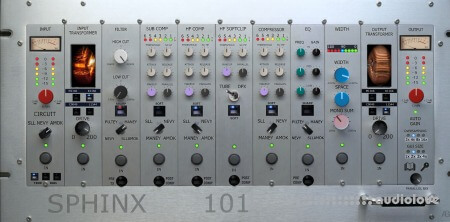
Sphinx 101 | Master bus processor. Component-accurate analog modeling with TrueRail Technology. Three main circuits - SLL, Nevy, Amok - with twelve analog modeling mechanisms tuned to the harmonic and dynamic signatures of the modeled console classes. Added with known hardware circuits - Pultey, Nevy, SLL, Amok and Maney - for EQ, Filter and all Dynamic Modules.
Twelve mechanisms. Always active.
01 Summing amplifier finite bandwidth
Real amplifiers aren't perfect. Our modeled summing amp rolls off at the frequency extremes, adding warmth that no EQ curve can replicate - because it's not EQ, it's physics.
02 Per-component manufacturing tolerance
No two real capacitors are exactly 100nF. Every component in Sphinx has randomized tolerance within real specs (±1% resistors, ±5% caps, ±10% transistor gain). Your left and right channels process through slightly different circuits - natural stereo depth impossible with mathematically perfect components.
03 Thermal drift
Three independent slow oscillations modulate circuit parameters over time. The sound breathes - never quite static, just like hardware that's been powered on for an hour. Per-component value modulation is small but audibly active across the chain.
04 Power supply rail sag
When the compressor clamps hard, it draws current from the shared supply. The rail voltage dips, affecting every other stage's headroom and saturation point. This is the "glue" that makes analog bus compressors feel cohesive. Every module pulls current AND reads the rail back to adjust its own operating point - a two-way loop, just like real hardware.
05 Cross-channel crosstalk
Real hardware shares a chassis, a power supply, a circuit board. Signal leaks between L and R - frequency-dependent, stronger in the lows. Sphinx models this coupling, creating a "wide but cohesive" stereo image that mono-summed processing can't achieve.
06 Transformer core hysteresis
The input transformer uses a Jiles-Atherton magnetic model - the same math used in electrical engineering to model real cores. It remembers its recent magnetization history, producing asymmetric, program-dependent saturation that no static waveshaper can replicate. Each core's harmonic balance is tuned to match published electrical measurements of the modeled unit.
07 Harmonic chain accumulation
Each stage adds its own tiny harmonic signature. By the time audio passes through drive stage, transformer, compressor, EQ, and output transformer, these harmonics have accumulated and interacted in ways unique to this specific chain. Measured: H2 through H7 all present with circuit-dependent ratios.
08 Class-A crossover nonlinearity
The drive stage models the slight crossover distortion of real amplifier topologies. SLL (BJT) produces clean odd-order harmonics. Amok (tube) produces rich even-order harmonics with H2/H3 ratio exceeding 5:1. This is the "warmth" and "presence" that defines each circuit's character.
09 Crosstalk frequency shaping
The L/R coupling isn't flat - it's stronger at certain frequencies, consistent with how real PCB-trace coupling behaves. This creates frequency-dependent stereo interaction that contributes to the three-dimensional imaging analog consoles are known for.
10 Compressor program dependence
The compressor's behavior changes based on what it's been doing. A Vari-Mu tube compressor working hard has a different gain reduction curve than one that's been idling. Beat 8 of a drum loop produces measurably different compression than beat 1. Measured: up to 82% program-dependent variation.
11 Transformer memory
The core's saturation curve depends on recent signal history. A loud bass note changes the magnetic operating point, affecting how the transformer handles the next transient. This "memory" creates the living, breathing quality that separates real transformers from static saturation curves.
12 Inter-module phase interaction
Each module introduces frequency-dependent phase shifts. These interact across the chain, creating subtle constructive and destructive interference at module boundaries. This is what gives real analog chains their characteristic "depth" - the sense of front-to-back dimension that digital processing rarely achieves.
Home page
DOWNLOAD