
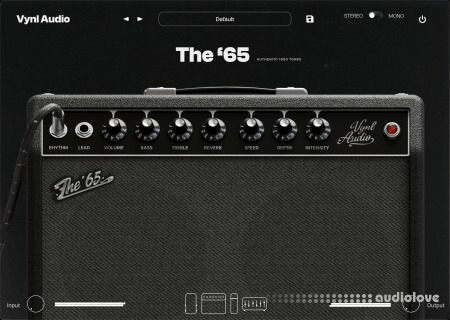
The most authentic amp sound in a plugin. Authentic 1965 tones
Everything is starting to miss the human feeling of plugging into a real amp. The '65 is built to bring that back.
Signal Chain. How We Got The Sound
Pedals (01 - Effects Chain)
Compression, overdrive, and chorus - built in before the amp hits. Dial in exactly how much grit and width you want going into the chain, so the amp responds the way it would to a real pedalboard.
Amp (02 - Full Amp Simulation)
A complete 1965 Fender Deluxe Reverb. The warmth, the bloom, the spring reverb - all of it. This is the amp behind some of the most iconic guitar tones ever recorded, and it sounds exactly like it should.
Mic (03 - Mic Stage + Cabinet IR)
Choose how the cabinet gets captured - a condenser for air and depth, or a dynamic for that tight, punchy studio sound. The mic placement is already dialed in. It sounds like a real recording session.
EQ (04 - 9-Band Graphic EQ)
Shape the final tone after the amp and cabinet. Cut the muddiness, bring out the presence, make it sit in a mix. Simple, visual, and exactly what you need at the end of the chain.
The Sound. Why The '65 sounds different
Most amp sims model the preamp and stop. The 65 models the full chain - preamp, passive tone stack, power amp, spring reverb tank, vibrato, and cabinet - because the tone of a 1965 Deluxe Reverb comes from every stage interacting with the next one. Leave any of it out and it stops sounding like the real thing.
The '65 in action
All previews are processed exclusively with The '65.
The '65 Demo Electric Guitar - Default Electric Guitar - Driven Crunch Electric Guitar - Hot Bridge Electric Guitar - Indie Chorus Wash Electric Guitar - LA Session Electric Guitar - Nashville
Everything in one plugin
The amp, the spring tank, the pedals on the floor in front of it. Everything that was in the room when that sound was made.
Tube Amp Spring Reverb Vibrato Compressor Overdrive Chorus Cabinet IR 9-Band EQ Mono Mic Stereo Mic
Genre Map. Built for everything.
The '65 Deluxe Reverb was in more rooms, on more records, in more genres than any other amp. Plug in and you'll hear why immediately.
Blues & Soul: Texas Blues, Chicago Blues, Delta Blues, Blues Rock, Soul, R&B, Motown, Neo-Soul, Funk
Country & Americana: Country, Country Rock, Outlaw Country, Alt Country, Americana, Southern Rock, Folk Rock, Singer-Songwriter
Rock & Alternative: Classic Rock, Surf Rock, Garage Rock, Psychedelic Rock, Indie Rock, Alt Rock, Grunge, Shoegaze, Dream Pop, Soft Rock, Punk Rock
Gospel & Worship: Gospel, Southern Gospel, Contemporary Worship, CCM, Hymns, Praise
The Machine. The amp that defined American guitar.
There's a reason the '65 Deluxe Reverb ends up in every great guitarist's living room. It's not the biggest amp or the loudest - it's the one that always sounds right. Clean enough to stay clean, pushed enough to break when you want it to.
Sit down in front of a real one and every control does something you can feel. The spring reverb splashes on big chords. The drive breaks up right at the edge. The tone stack responds to how hard you're playing. That's the experience The '65 is built around.
Built by ear against the real hardware - not from a spec sheet. Adjust the knobs the way you would in a room and it responds the same way. Throw a few pedals in front and it reacts to them the same way too.
The most authentic amp sound in a plugin. Sit down in front of a real Deluxe Reverb and every control does something you can feel. That's what The '65 is built around - not modeling the spec sheet, but recreating the experience of actually playing through one.
How The '65 was developed: We started with a 1965 Fender Deluxe Reverb. Not a schematic, not a sample library - an actual amp. We ran signal through every stage, measured the response at each point in the chain, and built DSP from the ground up to replicate what we heard and saw. The tone stack was the hardest part. The original Fender passive tone network is a component interaction, not a simple EQ - the Bass, Treble and Volume controls all affect each other. We modeled the full passive network with the correct logarithmic tapers and component loading so the controls behave exactly the way the knobs did on the hardware. The spring reverb and vibrato came last. Spring tanks have a specific kind of flutter and diffusion that algorithmic reverbs never get right. We built a multi-tap simulation with real diffusion modeling. The vibrato channel is optical tremolo - volume modulation, not pitch. Fender called it Vibrato on the original amp and we kept the name, because that is what it says on the hardware.
The '65 Info
Formats: VST3 AU Standalone
Presets: 27 factory presets included
System requirements
Mac: macOS 10.15 Catalina or later
RAM: 4GB minimum 8GB recommended
Plugin: VST3 AU Standalone 64-bit host required
4,000+ musicians using Vynl Audio
Home page
DOWNLOAD