
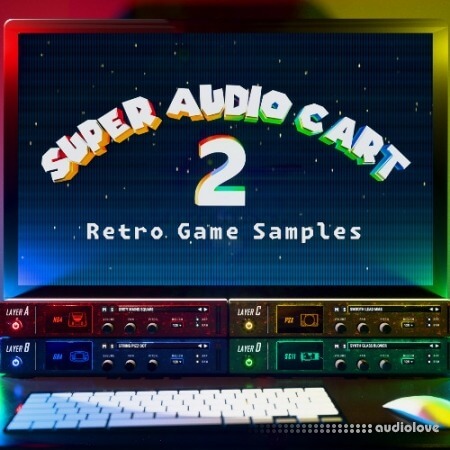
The legendary 8-bit, 16-bit, and 32-bit/64-bit eras of gaming in sample library form.
Exhaustively sampled from 19 distinctive consoles, handhelds, and sound chips.
The first library EVER to delve into platforms like the Nintendo 64, SampleCell II, and PlayStation.
Over 6,000 authentic sound sources, from simple waves to timeless acoustic PCM samples.
Customize, tweak, and transform sounds with a massively powerful synth engine.
The ultimate compendium of video game musical history.
From the Atari 2600 (1977) to the Game Boy Advance (2001), Super Audio Cart 2 encompasses multiple generations of legendary audio hardware - even obscure chips such as the VRC6 (a Japan-only add-on to the Famicom), SampleCell II (a hardware-based sound card), and the MSX Home Computer.
Far beyond mere pulse waves, bleeps, and bloops - although it has plenty of those, too! - Super Audio Cart 2 includes virtually any instrument you can imagine, taken straight from the worlds of your favorite games and systems.
100% authentic and royalty-free.
Many of the included systems used PCM sample playback rather than pure synthesis. We did not 'rip' samples from existing games; we spent years painstakingly recreating thousands of classic sounds from scratch using our own sample catalog and careful editing. Where applicable, these sounds were then played back directly from the original hardware for maximum authenticity.
In other words, the sounds in Super Audio Cart 2 are as close as possible to the sounds you remember from your favorite retro games, without any need to worry about copyright infringement or royalties.
Our dream ROMpler comes to life.
Systems like the Nintendo 64 and original PlayStation could play full audio tracks, rather than individual samples. In this era, composers used gear like the Roland JV-1080 and SC-88, Korg M1, Akai S1000, E-mu Proteus, and many others, which were then colored by playback on the consoles themselves to create the distinctive (and now nostalgic) music of this generation.
We followed a similar process to ensure that Super Audio Cart 2 was equal parts authentic and usable. But rather than merely 'ripping' sounds from these hardware units, we took an insanely difficult (but much more versatile) path: we created our own virtual dream hardware with its own “Impact Factory Library” (IFL).
The IFL covers all General MIDI sounds and much more, just like the hardware that inspired it. We recorded and edited samples to match the style of a mid-90s sampler.. and then re-sampled them for the N64, PSX, SNES, and GBA, exactly as would have happened for video game music at the time - thus giving us the highest possible authenticity.
These are sounds you've never heard before. And yet they will seem immediately nostalgic if you've played games from that era or used classic MIDI hardware from the '80s to the '90s!
Created by game music fanatics.
Every developer who worked on Super Audio Cart 2 has a deep connection to video game soundtracks. Over the years, we have arranged video game music, studied it, owned an array of consoles and MIDI hardware, and written our own retro-inspired game soundtracks. We are obsessive perfectionists, especially about things we care about, and we care a lot about video game music.
Simply put, this is our ultimate passion project, a true labor of love. It's everything great about the original Super Audio Cart and its later expansion Super Audio Cart PC, plus so much more.
Overall Features
@@qq@@- Four layer power synth architecture
- Independent settings for every layer, including arpeggiator and sequencer
- Intelligent sound browser
- Extensive performance configurations, including synth legato and portamento
- Eight macro knobs and two XY pads
- Four channel Console FX rack plus master channel, over 40 effects modules
- MODRIX with unlimited sound design and performance design capabilities[/spoiler]
Layer Sound Features
@@qq@@- Pitch bend range, keyboard trigger range, and velocity range – useful for multi and split patches
- Mono, legato, portamento, fingered, constant time, and fixed pitch modes
- Adjustable velocity to volume, filter cutoff, and pitch envelope
- Amplitude envelope with optional gate (fixed length)
- Dedicated filter and pitch envelopes
- Over 30 filter models, including Moog, Oberheim, and various other types
- Five vibrato waveforms with optional fade-in[/spoiler]
Layer Arpeggiator Features
@@qq@@- Two modes: arpeggiator (alternates between held notes) and sequencer (generates patterns based on held notes)
- Up to 32 steps, speeds of 1/128 beat to 1 measure per step, or 10ms to 1s per step
- Optional DAW grid sync (play only on specified beats or subdivisions)
- Volume, panning, and note length tables
- Modulator table driven by MODRIX
- WAVE table available for 8-bit systems (switch waveforms per step)
- Up to 4 octaves, swing control, 8 note playback orders
- Macro options (disable/enable all steps, gallop, tie all steps/every other etc.)
- Three loop end behaviors: loop, stop (one-shot playback), hold (holds final note)[/spoiler]
Modrix Features
@@qq@@- 13 core modulator types: envelope, LFO, stepper, velocity, keyswitch, MIDI CC, velocity range, key range, CC range, pitch bend, aftertouch, random, arp mod table
- 8 assignable macro knobs and 2 XY pads
- Route to virtually any per-layer parameter (other than arp), plus any instantiated FX parameter
- Edit per-routing base values, mod depth, and curvature in a single view
- 'Bounded' modulation toggle to intelligently scale mod range
- Additive or multiplicative modes when multiple mods are routed to the same destination
- LFO retrigger, unipolar/bipolar toggle, free or DAW sync, phase, rectify, 7 waveforms, quantization from zero to extreme stepped
- ADHSR envelopes with independent curvature for attack, decay, release[/spoiler]
FX Section Features
@@qq@@- 8 FX slots per layer, 8 main insert slots, 8 main send slots
- Per-channel mute, solo, volume, presets, panning, output routing
- Analog and Parametric EQ
- Four compressors, transient designer, two limiters
- Three chorus/vibrato, two phasers, two flangers, rotator cab, wah pedal
- Ring modulator and Freak modulator
- Two fuzz pedals, three distortions, two saturator (normal & tape), wow & flutter
- Simple lo-fi and advanced Bite lo-fi modules with bit depth, jitter, sample rate, dither, expansion, saturation, etc.
- Five guitar amp models
- IR-based guitar cabinet loader
- Reverbs: Raum, Convolution, Galois, Plate, Legacy, SNESVerb
- Delays: Simple, PsycheDelay (pitched and reverse), Replika (multimode including tape), Twin Delay
- Stereo modeler and stereo tune[/spoiler]
Content
Nintendo 64 (N64)
Classic mid-'90s Nintendo nostalgia. No dedicated sound chip or audio RAM, so developers were only limited by computing power and cartridge data storage. Most games hit the 'sweet spot' of 16-bit audio produced at 32kHz or 22.05kHz.[/spoiler]
PlayStation (PSX)
CDs instead of cartridges meant multiple audio playback styles and capabilities. SAC2 emulates the PSX's audio chip, which could be used for sequencing samples compressed as VAG – a more modern iteration of the ADPCM BRR algorithms used on the SNES.[/spoiler]
SampleCell II
A popular soundcard from the early '90s. Not a true sampler, but functionally a ROMpler with user-editable soundbanks, able to replay up to 32 voices across 8 channels. SampleCell II's Factory Library notably used in the soundtracks of Super Mario 64, The Legend of Zelda: Ocarina of Time & more.[/spoiler]
Game Boy Advance (GBA)
Early-'00s handheld with no dedicated sound chip, so samples varied from developer to developer and from game to game. Very electronically noisy, which combined with poor fidelity & tuning of most audio samples to create a distinctive sound. SAC2 balances usability and grunge to capture this aesthetic.[/spoiler]
Nintendo Entertainment System (NES)
America's favorite '80s console. Ricoh 2A03 APU with 5 channels: 2 pulse channels. 1 triangle channel. 1 noise channel. 1 lo-fi DPCM channel. Pure nostalgia.[/spoiler]
Sega Genesis / Mega Drive
Arcade-inspired late-'80s console. Yamaha YM2612 FM synth and SN76489 PSG chip. 6 channels of stereo 4-op FM sound. 1 channel of 8-bit PCM sample playback. Noisy DAC.[/spoiler]
Commodore 64
The MOS 6581 SID chip from a widely-used '80s home computer with audio capabilities beyond even many dedicated synthesizers of the time. Three independent oscillators. Four waveforms. Volume envelopes, ring modulation, oscillator sync, and multi-mode filter.[/spoiler]
Super Nintendo Entertainment System (SNES)
Enormously popular home console at the heart of the original Super Audio Cart. Up to 64KB of BRR samples across up to 8 channels. 16-bit/32kHz audio. Pleasantly lo-fi and super nostalgic.[/spoiler]
Game Boy
The definitive handheld console of the 8-bit era. Two pulse oscillators. One 4-bit PCM sample channel. One noise generator. Enormously popular among modern chiptune musicians.[/spoiler]
AdLib Music Synthesizer Card
Groundbreaking '80s-'90s sound card from the early digital music scene. Uses FM synthesis to produce multitimbral instruments and sound effects via the Yamaha YM3812 sound chip.[/spoiler]
Amiga 500
The sound chip of a popular late-'80s gaming computer. 4 hardware-mixed PCM channels of 8-bit PCM audio, up to a sample rate of 26kHz.[/spoiler]
Sega Master System
An early home console, a competitor to the NES in the mid-80s. Sound chip is a clone of the TI SN76489. 3 square wave generators. 1 noise generator. 16 attenuation levels.[/spoiler]
Aegis Sonix
One of the very first software synths in the mid-'80s, a cutting-edge digital replication of a highly capable (at the time) hardware synth. Produced for the Commodore Amiga. One oscillator. One LFO. Pure style.[/spoiler]
Atari ST / POKEY
Soundchip from the best (and final) line of Atari home computers, which were renowned for their MIDI capabilities and highly popular with electronic musicians at the time. Thick sound. Multiple forms of distortion.[/spoiler]
Tracker / Ultimate Soundtracker
Commodore Amiga tracker (a form of PC-based synthesizer) from the late '80s. 4 pitch- and volume-modulated channels of 8-bit 8SVX PCM samples.[/spoiler]
WinGroove
Mid-'90s PC application that enabled higher-quality playback of MIDI files via its own set of samples. (We worked with the creator to retrieve the source files and loop data to provide THE authentic sound set in Super Audio Cart 2!)[/spoiler]
ASCII MSX
'80s home computer, popular in Japan and Europe. Square waves. Hi-fi 3-voice PSG with better pitch accuracy and resolution than most sound chips of the era. Could use additional FM sound chips via expansion cartridges (also included in SAC2!).[/spoiler]
Famicom (VRC6, VRC7, Disk System)
Released in the early '80s, Japan's version of the NES had expanded sound capabilities compared to the NES. Some game cartridges used sound chips; VRC6 adds two additional pulse channels and a saw channel, and VRC7 features an FM synthesis chip based on the Yamaha YM2413.[/spoiler]
6000+ authentic snapshots
All configured with era-appropriate envelope settings.
Sounds of every musical category
Enjoy sounds in categories like: Bass, Brass, Drums, FX (Sound Effects), Guitar, Orchestral Hit, Organ, Percussion, Piano (Keyboard), Simple Waves, Stringed, Strings, Synth FX, Synth Lead, Synth Pad, Synth Poly, Tuned Percussion, Voice, and Winds.
4 dimensions of tags
Every sound is tagged with console and category, 'source' (such as subtractive synthesis vs. PCM), and general tag attributes like Sustained, Tonal, Evolving, etc.[/spoiler]
Follow original console limitations or go way, way beyond.
Sound designers and synth heads, rejoice: Super Audio Cart 2 is far more than a staggeringly huge sample library. It's also a mega powerful (dare we say Blast Processed) synth/sampler engine with loads of creative sound design possibilities.
Dozens of filter models, fine-tunable control over legato, portamento, and voice behavior, a super deep arpeggiator with gating and sequencer capabilities, step modulation, envelopes, and a four-layer architecture to truly inspire unique patches.
But that's not all…
MODRIX: The most powerful modulation matrix ever?!
The original Super Audio Cart sported a flexible, versatile mod matrix, but we knew we had to do even better than that with the sequel. Enter MODRIX, the modulation system we developed in-house to offer every kind of movement and control imaginable.
Use a multitude of modulator types like envelopes, LFOs, MIDI values, key ranges, macros, X/Y pads… and connect them to basically any control you can think of: filters, pitch, volume, pan, effects, and even combine multiple routings for the same parameter together for complex, dynamic modulation masterpieces!
MODRIX routings can be tweaked to your heart's content with curvature controls, min/max depth, adjustable base, and so much more.
Requires Native Instruments Kontakt Player or Kontakt FULL v7.10.9 and higher!
Home page
DOWNLOAD